After finishing the ghost silhouettes me and the group agreed that the "Hanged Man" (Number 2) and "Jimmy Squarefoot" were the strongest and were the most worthy of further development. Those 2 enemies would get a full written profile and a visual touch up. After researching how to make the ghosts look more ethereal.
After some research I found this painting of a ghost ship and found that light desaturated blues worked well for the job I wanted to perform. The first iteration of the Jimmy and the hanged man came out way too blue. Although they looked like ghosts, they looked like they were from Scooby-Doo or some other cheesy interpretation of a ghost. This isn't exactly the sort of look I wanted my ghosts to have. The group also made the point of saying that they wanted some indication of colour rather than plain monochrome. I argued that too much colour would make the ghosts look too solid and less ethereal. I managed to find a comprise point however by adding a low ocapicity layer with some basic colour over the top.
The Hanged Man
Jimmy Squarefoot
After this my next job was to create the secondary character, James. As a group we had decided that he would have been close to figuring out the cause of the supernatural happenings in the village 200 years ago when it all started. He was killed during these events and had come back as a ghost to use Anne to interact with the world in the ways he cannot. He convinces her that he is a medium. This serves as a way of explaining his supernatural abilities.
For the modern version of James, Juliette suggested this suit:
With this coat:
For his hair I wanted to give him something that could work for a modern medium and a Victorian academic. I chose to replicate, more or less, Oscar Wilde's hair.
I'm not overly happy with the final result. I felt they were under researched and that I didn't spend enough time on them.
Modern James
I think the face is a little unrealistic and under developed, especially when compared to Anne. Regardless of this I have had to leave it (for now) due to time constraints.
I have very similar critical views on the Victorian version of James. I chose this outfit:
Again I do not think this is nearly as refined as it should be I would like to preferably redo the design if time permits.
Having finished with the visual work I wanted to work on the character profiles. The original profile for the main character the thought was too dramatic and gave her too much character. After a discussion with our tutor Matt I realised that the main character should be more of a "blank slate". I did this by leaving a lot of details out of her life and giving her a very basic motivation. She is a journalist trying to prove herself by investigating the village.
James has a bit more of a complex history. The group seemed to disagree with James being a journalist too. I found the best 19th century occupation for him was that of an academic studying natural philosophy. In his search for natural answers to the events in the village, he finds that the only answers available are far from natural.
The next profiles I was required to write were the enemy profiles. I didn't seem to get much resistance on this and feel more than happy that my stories and designs work well for our game.
One of my roles in the group was to design the enemies for the game. Although the majority of the design and its connectivity with the rest of the game is left to group meetings, I still deal with the smaller details and the individual visual design, story background and mechanics each one works by. I decided to start off with the visual designs.
We all agreed upon how the enemies would work. Each and every enemy would have AI that allowed them to follow you and hide from you. Although we haven't quite decided how the enemies would hide from you, we have pretty much agreed that they should be invisible for the most part. You would be alerted to their presence through the appearance of frost or icy breath. You would see their location from paper moving, wet footprints and clever sound design. We also discussed how enemies would only become visible just before you catch them.
With this in mind I wanted each enemy to be unique. Having hordes of copied and pasted zombies or enemies may be good for an action game, but for a horror where you don't need hordes of enemies you only need a few, if not one. This means you can give it a backstory and it's own way of moving. Since our game is split into multi-linear side quests that eventually link with a main story arc. Each story can have anywhere between 1 to 3 enemies. Enemies cannot be killed/exorcised without completing the story they are linked with. The only way to repel them is to use the camera flash. This uses up your limited supply of battery and will merely buy you time.
Since all the enemies are unique and have a fairly simple way of repelling them, I can make each one wildly different from each other. When I was developing the main character I had a fairly strong idea of what I wanted her to look like so developed her by layering sketch over sketch until I had one I wanted to work on and paint. With enemies the wide variety and strong visual element led me to use the silhouette method to design 6 different ghosts, then allowing the group to pick two to develop further. Because of this method each enemy would be instantly recognizable and have a strong visual starting point for further development. I used a tutorial by the concept artist Feng Zhu as a base for the technique I used.
This gave me a very good idea of what I was doing. An especially useful piece of advice this tut gave me was that I should keep everyone different from the next with enough detail that a good 3D artist could create a model just from that silhouette.
In my search for inspiration I borrowed two books from the Norwich Forum Library: The Most Amazing Haunted Places in Britain (Readers Digest, 2009) and The Encyclopedia of Ghosts and Spirits (Guiley. Rosemary Ellen, 2000 2nd Edition). The former wasn't particularly useful simply because the stories were too brief to give a real visual feel for the ghosts. The latter aloud me to look up obscure spirits and stories which lead to almost indirect inspiration. After spending a couple of hours reading this book, I found that everyday things would naturally form the idea of a ghost in my head. Most of the ghosts, however, take very indirect and subtle influence from many places.
The ghost silhouettes with colour added to any that I want to draw particular attention to.
1. This design was based loosely off of "The Skullkid" from the Legend of Zelda series (Nintendo, 1986).
SkullKid from the Zelda series
The character is a young boy who carries a butchers cleaver and wears a ironically cheerful mask. He is lost in a perpetual game of hide and seek meets tag. He will deliberatly hide in rooms waiting for you to come close and face away. He then creeps up and takes you. The idea being that he will give clues as to his rough location by singing or appearing in front of you briefly. You must then try to deduce where exactly he is hiding and flash him with the camera so that he cannot get you.
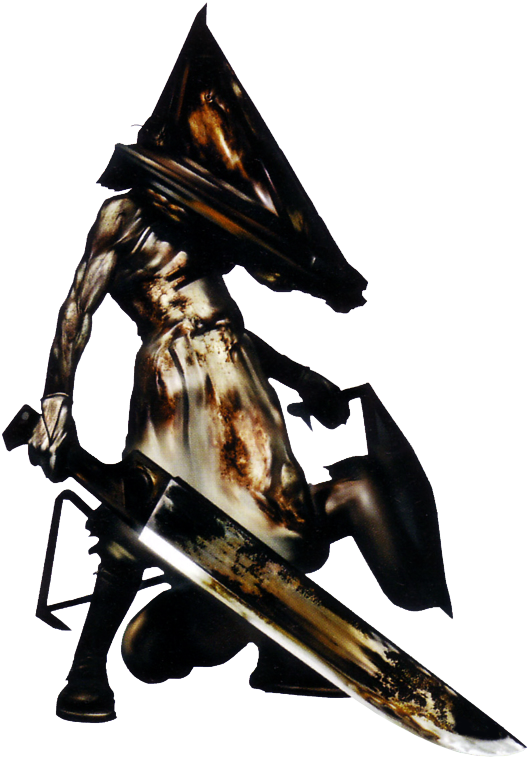
2. The "Hanged Man" was just an idea I had in my head and decided to work upon. A part of this was the idea of Pyramid Head from Silent Hill 2 (Konami, 2001). The idea of an enemy that drags himself around shows both agony and the anger and vengeance to force himself to continue to drag it.
Pyramid Head from Silent Hill 2
The Hanged Man drags the beams from the gallows around with him with the noose still around his neck. Clues to his location are given from the sounds of dragging and chocking noises. Despite being slow, he can throw the beams of the gallows at you, knocking you onto the floor preventing you from snapping him with the camera. He can easily be outrun, but he can try to anticipate your path and try to cut you off or trap you.
3. This character is based on a section on Hermitage Castle in The Encyclopedia of Ghosts and Spirits (p181). This article mentions an evil lord, Lord Soulis, who was bound in a lead sheet and chains and then boiled alive. He is an alternative to the hanged man. He behaves in much the same way, dragging around his ball and chain.
4. The drowned woman has very little direct influence, rather an "organic" idea. She appears as a pool of water which runs like normal water. She can drag herself half out of the water and slowly drag the pool around. She can also appear out of existing pools of water. This means the player should avoid water and run away from any moving pools. The only clues to her arrival is the pool she dwells in.
5. Based more directly off of an article from The Encyclopedia of Ghosts and Spirits (p201), Jimmy Squarefoot. Jimmy Squarefoot is a spirit that has a pigs head and wanders the earth on square peg shoes. I decided that this was too "otherwordly" and instead had the idea of a butcher who was murdered by being shoved into the front half of a pig and choking on pigs blood. The ghost moves like a giant boar. It will charge you extremely quickly. It will be invisible but give off visual and audio clues as to it's location such as dust trails and stamping. This will give you a chance to flash it with the camera before it hits you.
6. The Old Hag is something I have known about for a long time from no specific source. The old hag is a fairly common dream shared by many people for a long period of history. The Old Hag is a nightmare. The dreamer first experiences sleep paralysis where they are aware but cannot move. They then see an old hag in the corner of the room who slowly approaches the bed. The old hag then slowly climbs onto the dreamers chest and strangles them. This will be difficult to implement into gameplay but will be interesting if we do.
After meeting with the group we have finally began to string together a rough structure for our re-imagining of Fatal Frame II. We have not yet decided on third or first person gameplay, but we are leaning toward third to keep the gameplay a little closer to the game that inspired ours. Although we have not settled on an exact location, we have decided that, like the original our game will take place in an abandoned village. Ours, however, will be European.We want to keep the focus on one character but have another character to drive the story along and give the players an emotional connection to what's happening in the game. This echoes back to fatal frame two where the story revolves around two twins. However, we want the game to include extra mechanics with this extra person, e.g. the other person can reach places the main character cannot.
After a meeting with one of the tutors, we came up with the idea of using a sort of early warning system for the presence of ghosts, much like the radio in the Silent Hill (Konami, 1999) games. Our idea is to use frost and icy breath based on reports of ghost encounters. The enemies will be made up entirely of AI controlled ghosts. The AI control will allow the ghosts to act independently, hopefully producing unpredictable and scarier experiences. The ghosts will not be visible most of the time, hiding in shadow only revealing itself just before attacking. There will, however, be clues as to where it is. The player will be armed with a Polaroid camera which will both repel ghosts from attacking and allow the player to solve puzzles by showing items and clues that are visible only on film, this could include items that belonged to the ghost which are no longer there. The game will take place over one long night in the village in which the main character and their companion is trapped. The player will move from location to location solving dynamic puzzles in order to resolve the dead's unfinished business. This will "exorcise" the ghost and open new doors to the player, allowing them to go deeper into the village.
First sketch
After the meeting we split the labor between us.Jack took settings and items, Juliette took game mechanics and I took enemies and characters. The image I had in my head was of a strong but perhaps emotionally vulnerable. We all knew we wanted to make her a reporter, so, I initially gave her a shirt and jeans. I wanted her to look interesting so gave her a rigid nose to make her a little less pretty. The reason for this being, if a character is too good looking I think it can take away from their character.I coloured the initial sketch in order to start a more active dialogue with the group about changes. The group told me that the hair was a little too "piratey" and the nose need to be fixed. They also told me the jeans were too flared and needed to be straightened. Juliette also gave the suggestion that I should give her a cardigan.
Final iteration
The final iteration took all of these suggestions into account. I have to say that I do prefer her after making the suggested changes. Despite this, I feel like I should have gotten a lot further with the design than I did. I had the intention of turning it into a full painting with no linework. However, I found that, due to my fairly low skill level, it took me way longer than I feel it should have to get this far. I am very eager to improve my drawing skills. Although I do not want to be a games designer, which does not necessarily require good drawing skills, I do enjoy getting my ideas out in this way.
I am currently working on a personal profile for her. I have been trying to work out a history alongside her personality so I can almost let her flaws and qualities shape themselves. The current profile is as follows:
Name: Kate/Anne
Age: 23
Gender: F
Occupation: Journalist
History
Born to a well off supportive family. Lost them in suspicious circumstances, drowning or similar (The disturbing past is important as it adds depth by giving meaning to her flaws). This will have happened at around 10 years old (too young without any consistent authority figures and/or caregivers and she is likely to develop psychopathic tendencies, this is not a good hero character) She will have lived in the countryside.
Upon the death of her parents she moved into an orphanage where she struggle with the death of her parents by turning to delinquency, even running away a few times (this is a good device to introduce new flaws or elements in her past like drugs and violence if required). In her mid teens she is given a new tutor who is both kind and commanding and gives her a new parent figure. Her tutor introduces her to literature.
Inspired by the stories and writings she has recently been introduced to, she decides to become a recognized writer. Under the guidance of her tutor, her grade slowly increase and she gains her degree from a decent university. Her writings are found by a large, national newspaper and she takes a job as a small columnist.
After a lot of hard work she is given a big investigative piece to prove herself. The case of the lost village...
Personality Traits
Outwardly resilient and strong
Inwardly insecure
Driven (As a way of proving her insecurities false to herself)
As a task for Contextual Studies we were asked to read an article by Jasper Juul called Games Telling Stories. The article covers the difference between narrative and games. The article specifically chooses to separate games as narrative, that is a story telling device, and narrative within games, a film like story told almost as a reward and incentive for playing the game.
My first point on the article is its over-ambition to seem academic. Although I believe that games can, and should, be studied in an academic way, there is no need to entirely conform to language which establishes an academic text. Academic writing, from my point of view, requires two things; overall objectivity and evidence to back up your points. Both of these things can be achieved with engaging language that makes the reader want to keep reading.
Juul starts his article with the argument that everything is essentially apart of a narrative due to the subjective nature of the mind and its way of forming anything into a part of a narrative in order to make sense of the world. He then make the counter argument that "Narratives
may be fundamental to human thought, but this does not mean that everything
should be described in narrative terms. And that something can
be presented in narrative form does not mean that it is narrative." He then goes on to point out the difference between a story within the game and using the game to tell a story. i.e. A game like Half-Life that uses film theory to create a sci-fi story that works with the game is an example of a narrative within a game. Space invaders has no cut-scenes or writing just an overarching premise of an invasion which is told through the game itself. I agree that these are important distinctions to make when designing a game and every game designer should try to make a point of telling a story through gameplay as much as possible.
Juul then makes a point of showing how games translate narrative elements into the gameplay. His main point on this section is that games do not directly translate into narratives. He points out how key narrative elements translate in games, such as narrative events into a simulation with multiple outcomes, or characters into the players position in the game. An example he used for all this was that the recounting of gameplay would be extremely dull, like explaining every move in chess. Firstly I think that this example is kind of redundant on the principal that it still forms a mental narrative while in the act of play in order for your mind to get make sense of the events happening to you, dull or not. I also think that in-game events can be recounted in a certain way. Dungeons and Dragons is a good example of this. People who play this game are often teased on account of saying things like, "...so I used my +5 frost Axe on the troll, I rolled a critical and he exploded!" Although this is admittedly a mix of narrative devices, such as the troll and the axe, game elements, such as the +5 frost and critical roll, are also included and form a part of a narrative about gameplay.
His next argument is that most narratives use the presumption that the story takes place before its retelling, even if the story takes place in the future, it usually still uses past tense. Games are thought of as happening now, due to your control over the events in the game.This is fundamentally true and a very good point. The difference in tense is undoubtedly an important factor in the way the story is told. This does not necessarily prevent it from being a story however.
Juul goes on to talk about the player as a character in the game. He states that the player need be the only character in the game. No character need appear on screen. This makes the retelling of the game difficult. I, again, disagree. I find that, through the players eyes, they are the character. This is a much more powerful perspective and allows for greater immersion into the experience. Again this does not prevent the game from being a narrative in itself.
His final argument is that avant-garde storytellers often disobey the rules above about narrative in order to create a different experience for their audience. Games are no different. However, he then argues that the often interpretive nature many of these avant-garde filmmakers and writers use would take away from the gaming experience. My thought on this is that although certain storyteller chose to mix their avant-garde storytelling methods with interpretive events does not mean that games also have to do this.
Overall I agree that the commonly accepted forms of narratives such as films and books do use many different method that games and so, in that sense, they are different. However, both stories, in all their forms, commonly accepted as being life teaching tools. Games are no different. Lion cubs play to practice hunting and fighting. In fact, tickling is thought to be a human preparation for combat! This means that both games and stories have the same ultimate aims. In this sense, does it matter how different they are? I believe that there is still a narrative whilst playing games, it is simply more immediate. A boxing match described later on will simply cover the superficial details of who appears to be winning and the best guess as to why. A boxer will be experience a much more immediate inner narrative, like a gamer, they will be looking for opportunities to take advantage of and analyzing every relevant detail. Although the narrative is different, it is still a narrative. A much more effective one at that.
As a part of a Contextual studies assignment we were asked to answer some questions on a game in a genre given to us, ours was Racing games. We chose fuel because it takes a slightly different approach in terms of freedom given to the player.
How is the game structured?
The game uses a "free-ride" mode to allow the players to ride around and find challenges on a very large map. You can do these challenges in any order you choose to but must earn stars and fuel from each race in order to unlock more map with more challenges to earn yet more stars and fuel. Despite this, the game has not strayed too far from what most other racing games do and still puts a lot of emphasis on the menu system. e.g. When you discover a challenge, you don't have to travel all the way to the challenges location to trigger it. You can just select it from the menu, provided you have already discovered the challenge. This saves the player time in traveling from place to place.
Do you have to follow a set path in the game?
As previously stated in the last question, the player can choose to complete the challenges available to him/her in whatever order they choose. However this, like most games, creates more of the illusion of freedom than any actual freedom. This is because the game is set up to allow the player to choose from a selection of unlocked challenges but is specifically designed to make sure they can only afford to go on to challenges that are doable at their current skill level. This is a sensible stance to take as a game designer as it prevents players from getting too frustrated. This does offer an interesting solution to the usually completely linear progression of racing games. In the races themselves, there is a definite increase in the amount of freedom given to the player compared to other racing games. The visual clues given (see below) as to where the end goal is allows the player to discover their own routes to that goal. This adds a lot more satisfaction when the player finishes first in a race or beats their best time, simply because they did it their own way.
What does the game look like? The game uses a variety of terrains and weather conditions to make an extreme American landscape in a realistic, if slightly exaggerated in detail, style. This, mixed with metal and mechanics of the cars, bikes, buggies and quads racing around, gives, perhaps, the feeling of mans dominance over nature. Above all though, this gives the player the feeling that they're prevailing in the face of the extreme. A variety of other visual elements are used, such as the arrows, which give a optimal direction for the player to go, and shafts of light, indicating goal locations. These are all in place to allow the player to clearly see their end goal without having to follow a predetermined route.
After a long summer, we are finally back in Norwich and ready for our first uni project. The task is to take one of five games and "re-imagine" them into something new, maybe even better. We are apparently aloud a fair amount of freedom with this one. The game's primary influence should be visible underneath it's new shimmering coat which we are to create for it, at least to those who look for it. Our choices were: Medal of Honor (EA, 1999), Flow (Thatgamecompany, 2006), Fatal Frame II; The Crimson Butterfly (Tecmo, 2003), The Portopia Serial Murder Case (Yugi Horii, 1983) and Moshi Monsters (Mind Candy, 2008).
For this project me, Juliette DesForges and Jack Eastoe teamed up. After some discussion we decided to go for Fatal Frame II. The primary reason for choosing this game was because of it's genre and it's way of approaching it. Having already researched the Horror genre for a previous project, we felt like we had already sharpened our analytical claws to the genre with extensive and were ready to use this as a foundation to create something truly terrifying out of a game which has a cult following of people who believe that it is the scariest out there.
The game is filled with Japanese cultural references. So as a first research task for all of us, we all decided to look into folk lore and legends in other countries to attempt to find a more relateable setting and theme for the game. I also wanted to spend some time playing the game in order to get to know how to really get to know how the game worked and how we could create something out of what this game does.
So far I have only spent one brief session playing the game, spending just enough time to get to know all of it's basic elements. The game clearly takes a huge amount of influence from Japanese horror films and the old Kaidan, traditional Japanese ghost stories. This is reflected in the game's themes, which are often heavily based on relationships between the deceased and their lack of coming to terms with this, and the games art style. The setting is also set in an old Japanese village which time forgot.
The game features a lot of flashback and visions which are choppy, grainy and yet show violently loud images and audio, like the fragments of a nightmare you just awoke from.The story tells of two twins one of whom wonders off into the woods, pursued by her sister, and into a creepy lost village. Which they then choose to explore, until one sister wonders off again and it's the job of the other sister to find and save her.
The gameplay is pretty typical of a J-Horror game. Fixed camera angles, slow movement and a flashlight all serve their usual purposes as in Silent Hill (Konami, 1999) and Resident Evil (Capcom, 1996). There is however a few key differences. The game relies much less on puzzles and more on combat than Silent Hill and the original Resident Evil games and more on it's unique combat system. The game requires you to take a picture of the attacking ghosts with the Camera Obscura. The only way to score significant amounts of damage, however, is to take the picture at the exact moment before they attack you. You will also occasionally allow you to take control of the wandering sister, however, this only seems to serve as a narrative element rather than an actual gameplay device.
My first, personal, impressions of the game weren't great. The game's constant desire to bombard the player with cutscenes feels unnecessary and often breaks the feeling of immersion. The combat allows for the player to see the enemy for way too long. Amnesia: The Dark Descent (Frictional Games, 2011) and Slender (Parsec Productions, 2012), now thought of as some of the scariest games out there, make a point of making looking at the enemy a bad thing. This emphasizing the desire to survive by getting away. Not only this, but the Fatal Frame II makes a point of throwing enemies at the player at nearly every turn. This means the player quickly gets used to seeing enemies and the fear factor is lost. Another problem with the combat is its power-up system. This gives you the ability to earn points and find items which can upgrade your camera, giving you a better chance of exorcising the ghosts. This does not suit the Horror game genre and makes the player feel as if they are playing a game instead of being in any real danger. The game also has a bad habit of having ghosts visibly walk into a room, you follow only to discover there is nothing there, then you leave the room and the ghost is outside. This can be an effective device for surprising a player, but the game overkills this method to the point where it is mind-numbingly predictable.
I have a few suggestions as to how to solve some of these problems. Most of the storytelling could be done in-game. Conversations between twins while moving from place to place, the main character vocalizing thoughts and good use of visual storytelling can all be used to make the narrative clear to the player in-game, without breaking the immersion or flow. Combat could be a last resort, only to be used as a means of escape. I also think that it should not be able to completely exorcise the enemies, only stun or distract them. This would wrestle the game back into the survival horror genre, where you spend more time running, too scared to look back, than looking at the slow moving enemy head on. It would also help if the only glimpses of the enemy where fleeting, just enough for it to be obvious that the enemy is getting closer. The camera could be upgraded with individual camera parts which can be attached to a 3D model of the camera. This avoids RPG-esque menus which, I feel, ruin the realism required to make a horror truly scary. Journals have been used to this effect in many games to show small extra pieces of information without going through any menus that break the mood. Improvements in the field of AI will help prevent the predictability of the enemies by removing as many scripted events as possible and replacing them with intelligent enemies. I also think that the sister, instead of just being used as a narrative device, could have abilities of her own, a different way of dealing with enemies perhaps.
After talking to a tutor, Mark, at uni, I have since lowered unnecessary edge loops, lowering the poly count. Now all polygons, as far as I can see, contribute to the shape. This didn't take long and was fairly easy.
I then decided to begin texturing. It was the roots I had initial trouble with. I tried hand painting the roots in Mudbox, however, this didn't give me nearly the effect I was after, so I took the diffuse (color) UVs into photoshop. I then tried placing a simple bark texture over the top and setting it to overlay. This didn't look right either, not showing any kind of real texture, although still better than just colour. I then searched the internet to try and find and find a good tutorial. Eventually I found this tutorial on using the Projection tool in mudbox to paint textures straight onto meshes and use them to sculpt with displacement maps. After a long search I eventually found the right texture but it didn't quite fit the colour scheme. I took it into photoshop and shifted the Hues and Levels around until I got a nice brown. After projecting it onto the model I didn't feel like I got the same tone as I did with the hand painted model so I set the opacity of the texture layer to 80% and set the layer to Overlay in mudbox. I then extracted the Ambient Occlusion layer and set it to overlay. After that I extracted the normal map and went back into maya. I then added an lambert material to the roots model and added the diffuse map to the colour layer and the normal map to the bump layer. The effect was perfect.
I then repeated the same process with the door, mushrooms, vines and floor. Once I had the technique down I had no real problems.
Once I had done this though I wanted to look at the foliage around the door. Knowing a good place to start was with flat planes but when I initially started this I found that it looked cheap and flat. After taking a quick jump into Skyrim to look at how the foliage was done there, I found that there were several planes carefully placed to make up the plants and foliage. I looked closely at how they had been arranged in Skyrim and tried to repeat a similar pattern This work very well. With this technique in mind I then looked at the leaf I had in the door frame. The mesh looked rigid and the normal map didn't do much to improve this. I then decided to use use a similar technique used in the Legend of Zelda; Ocarina of Time, the game I was taking inspiration for the door from, and deleted the leaf mesh and merged the vert left on the branch to make a point. I then took a high res leaf photograph and deleted the white background and saved as a PNG to keep the transparency. Then made a plane in maya split it 4x4, just enough to get the rough curved shape of the leaf, and then added the texture on top of it, including a normal map created with a "sculpt by displacement map" in mudbox.
Already being fairly familiar with point lights and directional lights and after having a look at the tutorial emailed to us on rendering from Mark, I set up 3 lights in the scene. One Directional light as a Key Light, for sunlight, which I gave a slightly yellow hue, wanting to give the scene a warm feeling. One ambient point light as a fill light, used for softening the shadow on the door from the roots with a slightly green hue to give the impression of diffuse light coming from the rest of the forest. Finally I set up a rim point light with a cool blue colour on the left side of the door to stop the warm colours of the other lights oversaturating the scene and the give the scene a bit more contrast. After a few test renders I discover that the lighting wasn't taking the transparency of some of the foliage into account. I found that this was because the lights and render setting weren't set to ray trace. After trying this with success in high quality renders with mental ray, I set up a camera with a pivot in the middle of the door and animated it to do a 180 degree swing around the door over 120 frames. I then render on production quality with mental ray into Targa files. I then discovered that I then used Adobe Premiere to compile the Targa files into an MP4 file. Unfortunatly, it is very difficult to find an application that will compile into .mov on a PC so have had to make do with MP4 on H.246 at 720p. This should be enough. If not, hopefully the uni Macs will have a media encoder I can use to convert into .movs.